

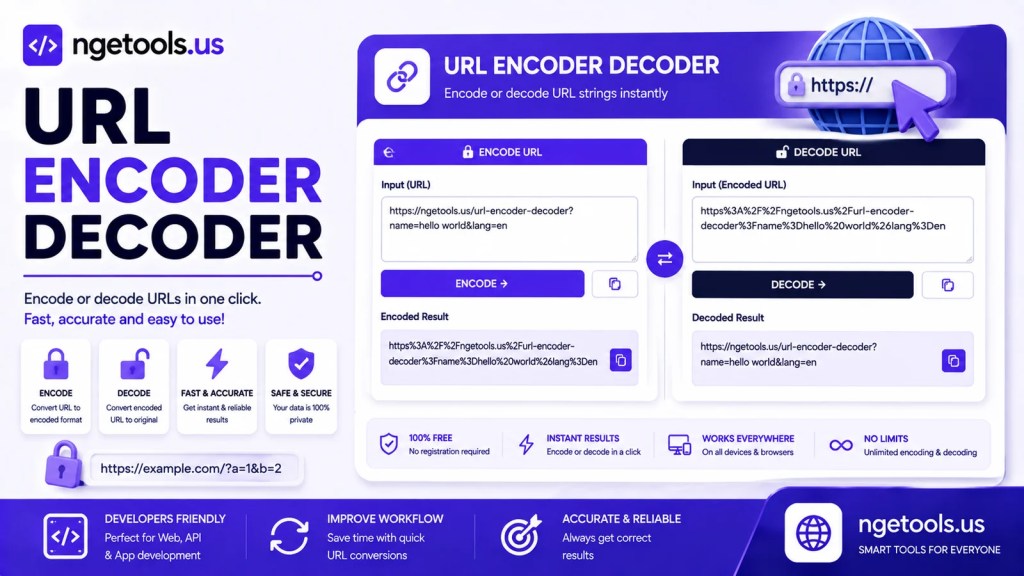
Use our free URL Encoder Decoder online to instantly encode or decode URLs, text, query parameters, and special characters. Fast, secure, responsive, and easy to use.
URL Encoder / Decoder
In modern web development, sharing data through URLs is an everyday task. However, URLs cannot safely contain every character you type. Spaces, symbols, and non-ASCII characters must often be converted into a web-friendly format before they can be transmitted correctly. This is where a URL Encoder Decoder becomes an essential utility.
A URL Encoder Decoder allows you to convert plain text or URLs into a properly encoded format and decode encoded URLs back into readable text. Whether you’re a web developer, SEO specialist, API developer, digital marketer, or student learning web technologies, this tool simplifies the process and helps prevent errors caused by improperly formatted URLs.
Our free online URL Encoder Decoder works directly in your browser with no installation required. Simply paste your text or URL, choose whether you want to encode or decode it, and receive instant results.
What Is a URL Encoder Decoder?
A URL Encoder Decoder is an online utility that performs two important functions:
- URL Encoding converts special characters into percent-encoded values that browsers and web servers can safely process.
- URL Decoding converts encoded characters back into their original readable format.
For example:
Original Text
Hello World!
Encoded Result
Hello%20World!
Likewise:
https%3A%2F%2Fexample.com%2Fpage%3Fid%3D100%26name%3DJohn%20Doe
becomes
https://example.com/page?id=100&name=John Doe
Encoding ensures that URLs remain valid and compatible across browsers, servers, APIs, and web applications.
Why URL Encoding Is Important
URLs follow strict formatting rules defined by internet standards. Certain characters have reserved meanings or are not permitted directly within a URL.
Characters commonly requiring encoding include:
- Space
- &
- %
- ?
- =
- /
- :
- “
- ‘
- <
- Unicode characters
- Emoji
Without proper encoding, URLs may:
- Break when opened
- Produce incorrect server requests
- Fail in API calls
- Cause security vulnerabilities
- Generate SEO crawling issues
A reliable URL Encoder Decoder eliminates these problems by converting text into a standards-compliant format.
Features of This URL Encoder Decoder Tool
Our online tool is designed to provide fast, accurate, and hassle-free encoding and decoding.
Instant URL Encoding
Convert plain text into URL-safe encoding in real time as you type.
Example:
John Smith & Company
becomes
John%20Smith%20%26%20Company
Instant URL Decoding
Paste an encoded URL and instantly convert it back into readable text.
This feature is particularly useful when debugging links, APIs, or tracking parameters.
Automatic Conversion
There is no need to click a “Convert” button repeatedly. The tool automatically updates the output whenever the input changes.
Copy Results
With one click, you can copy the encoded or decoded result directly to your clipboard.
Simple Interface
The clean design makes it suitable for beginners while remaining efficient for professional developers.
Mobile Friendly
Use the tool comfortably on:
- Desktop computers
- Laptops
- Tablets
- Android devices
- iPhones
The responsive layout ensures a smooth experience across all screen sizes.
Common Uses of a URL Encoder Decoder
This tool has numerous practical applications across different industries.
Web Development
Developers often encode:
- Query parameters
- Form values
- URLs inside URLs
- Redirect links
Encoding prevents malformed requests and ensures reliable communication between browsers and servers.
API Development
REST APIs frequently require encoded parameters.
For example:
search=machine learning
should become
search=machine%20learning
This guarantees accurate data transmission.
Search Engine Optimization (SEO)
SEO professionals frequently work with:
- Canonical URLs
- Tracking parameters
- Campaign links
- Redirect URLs
- UTM parameters
Proper encoding ensures search engines can correctly interpret complex URLs without errors.
Digital Marketing
Marketing campaigns often generate URLs containing multiple parameters.
Example:
utm_source
utm_medium
utm_campaign
utm_content
Encoding these values avoids broken campaign links and preserves accurate analytics.
Database Applications
Applications frequently store URLs in databases. Encoding helps maintain consistency and prevents invalid characters from causing parsing issues.
Testing and Debugging
Developers can decode encoded URLs to understand exactly what data is being transmitted during HTTP requests.
Advantages of Using an Online URL Encoder Decoder
There are many benefits to using a browser-based tool instead of manual encoding.
Fast Results
Encoding and decoding occur instantly without waiting for server-side processing.
No Installation
Everything runs directly inside your browser.
No plugins.
No extensions.
No software downloads.
Secure Processing
Client-side processing helps keep your text private because the conversion occurs locally within the browser.
Free Forever
There are no subscriptions, registration requirements, or hidden costs.
Cross-Platform Compatibility
Works on all modern browsers including:
- Google Chrome
- Microsoft Edge
- Mozilla Firefox
- Safari
- Opera
- Brave
Characters Commonly Encoded
Below are several examples of commonly encoded characters.
| Character | Encoded Value |
|---|---|
| Space | %20 |
| ! | %21 |
| # | %23 |
| $ | %24 |
| & | %26 |
| ‘ | %27 |
| ( | %28 |
| ) | %29 |
| + | %2B |
| , | %2C |
| / | %2F |
| : | %3A |
| ; | %3B |
| = | %3D |
| ? | %3F |
| @ | %40 |
Understanding these conversions is useful when troubleshooting URLs or working with web applications.
Best Practices When Encoding URLs
To avoid errors, consider the following recommendations:
- Encode user input before adding it to URLs.
- Avoid manually replacing characters unless absolutely necessary.
- Always verify encoded links before publishing.
- Decode URLs when debugging application requests.
- Use standard encoding methods for maximum browser compatibility.
Following these practices helps improve reliability and reduces unexpected issues.
Frequently Asked Questions
What does URL encoding do?
URL encoding converts special characters into a standardized format that browsers and web servers can safely transmit over the internet.
When should I encode a URL?
You should encode a URL whenever it contains spaces, symbols, Unicode characters, or dynamic user input that will be included in query parameters.
Is decoding safe?
Yes. Decoding simply restores encoded characters back to their original readable form.
Does this tool work on mobile devices?
Yes. The tool is fully responsive and functions smoothly on smartphones, tablets, laptops, and desktop computers.
Is my data stored?
No. The conversion is performed instantly in your browser, making it a convenient option for everyday URL processing.
Can I encode complete URLs?
Absolutely. You can encode individual words, sentences, query parameters, or entire URLs depending on your needs.
Why Choose This URL Encoder Decoder?
This online URL Encoder Decoder combines speed, simplicity, and accuracy in a single lightweight utility. Whether you need to prepare URLs for APIs, optimize marketing links, debug encoded strings, or ensure proper URL formatting, the tool delivers instant results without requiring technical expertise.
Its intuitive interface, automatic conversion, copy-to-clipboard functionality, responsive design, and support for both encoding and decoding make it an ideal companion for developers, SEO professionals, students, marketers, and anyone working with web addresses.
Conclusion
A dependable URL Encoder Decoder is an indispensable tool for modern web development and digital workflows. By converting special characters into URL-safe formats and restoring encoded strings back to readable text, it helps prevent formatting errors, improves compatibility, and ensures reliable communication between browsers, servers, APIs, and applications.
Whether you’re building websites, optimizing SEO campaigns, testing APIs, or simply sharing links, this free online URL Encoder Decoder offers a fast, secure, and user-friendly solution that works across all major devices and browsers.